Green Cards and Visas for Foreign Physicians: J-1, Conrad 30 and NIW
Foreign-trained doctors make up about a quarter of US physicians. Their path runs through exams, residency, visa rules and often a commitment to work where doctors are scarce.
ECFMG certification and the USMLE exams are required before US residency.
Most international graduates train on J-1 visas, which carry the two-year home residency requirement.
The Conrad 30 program waives that requirement for doctors who work three years in underserved areas.
A physician National Interest Waiver leads to a green card after five years in a shortage area.
International medical graduates (IMGs) fill gaps across the US health system, especially in rural areas and primary care. Their journey combines medical licensing with immigration planning, and the decisions made at the start of residency affect their options for years. This guide walks through the stages and the main immigration tools.
The visa you choose for residency can decide where you practice for your first three years afterwards.
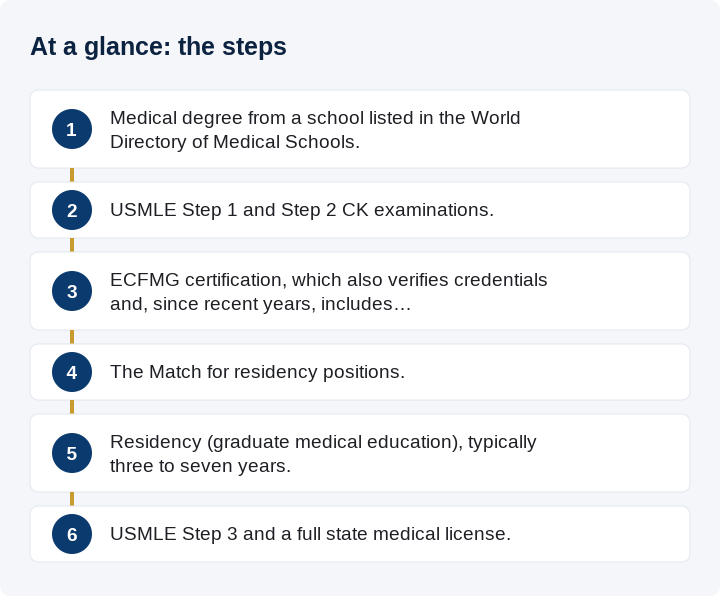
The main steps at a glance. Details in the sections below.
Licensing steps
Medical degree from a school listed in the World Directory of Medical Schools.
USMLE Step 1 and Step 2 CK examinations.
ECFMG certification, which also verifies credentials and, since recent years, includes communication skills requirements.
The Match for residency positions.
Residency (graduate medical education), typically three to seven years.
USMLE Step 3 and a full state medical license.
Several states have created alternative licensing pathways in recent years that let experienced foreign physicians obtain provisional licenses without repeating residency, often tied to work in specific settings. Rules differ by state.
Visas for residency
J-1 (ECFMG-sponsored)
H-1B
Availability
Accepted by most programs
Only some programs sponsor; requires Step 3 before
Two-year home residency
Yes, for physicians in graduate medical education
No
Spouse work
J-2 can apply for work permit
H-4 work only with conditions
Path afterwards
Waiver (Conrad 30) or two years home
Direct path to H-1B employment and green card
Teaching hospitals are usually cap-exempt for H-1B, but the 2025 $100,000 payment for certain new H-1B petitions for doctors outside the US has affected recruitment; exemptions for physicians have been discussed and requested. Check current guidance.
The Conrad 30 waiver
Each state can request up to 30 waivers a year of the J-1 two-year requirement for physicians who agree to work full time for at least three years in a Health Professional Shortage Area, a Medically Underserved Area, or for some flexible slots serving those populations. The physician must start within 90 days of the waiver and usually works on H-1B status during the commitment. Federal agencies such as the Department of Health and Human Services and the Delta Regional Authority run similar programs.
The physician National Interest Waiver
Doctors who agree to work full time in clinical practice for an aggregate of five years in a designated shortage area or a Veterans Affairs facility can obtain an EB-2 green card through a physician NIW, without PERM. The three Conrad years can count toward the five. The green card is not finalized until the service is completed and documented.
Other green card routes
Employer-sponsored PERM in EB-2 for physicians with job offers
EB-1 for distinguished physician-researchers
Family-based petitions
A worked example
A hypothetical internal medicine graduate from Pakistan matches into a residency in Ohio on a J-1. After three years, she accepts a position at a rural clinic in a designated shortage area. The state health department sponsors a Conrad 30 waiver; she changes to H-1B and starts work. Her employer files a physician NIW, which is approved. After five years of service, she submits evidence of the work, and her green card is approved.
Common mistakes
Accepting a J-1 program without understanding the waiver competition in the target state
Missing Conrad 30 application windows, which often open early in the federal fiscal year
Gaps in service that break the commitment
Ignoring the start deadline after the waiver
Timeline from medical school abroad to a green card
Years 1–2: USMLE Step 1 and Step 2 CK, ECFMG certification, US clinical experience if possible.
Match year: residency applications, interviews and the Match.
Residency (3–7 years): J-1 or H-1B; Step 3 during residency.
Waiver or employment: Conrad 30 or another waiver for J-1 physicians, H-1B employment.
Green card: physician NIW after five years of qualifying service, or employer-sponsored petition.
Choosing a Conrad 30 position
Check how competitive the state's program is and when it opens.
Confirm the facility is in a qualifying shortage area for your specialty.
Read the employment contract carefully: hours, call, termination clauses and non-competes.
Plan for the green card: many employers file the physician NIW soon after you start.
Glossary
IMG: international medical graduate.
ECFMG: the organization that certifies IMGs for US graduate medical education.
HPSA: Health Professional Shortage Area.
GME: graduate medical education, meaning residency and fellowship.
Family members
Spouses of J-1 physicians hold J-2 status and can apply to USCIS for work authorization. Spouses of H-1B physicians hold H-4 status, with work permits only in specific circumstances. When the physician obtains a green card through an NIW or employer petition, the spouse and unmarried children under 21 receive green cards as derivatives. Families should also note that J-2 dependents of physicians subject to 212(e) are generally subject to the same two-year requirement, and the physician's waiver covers them.
Frequently overlooked costs
USMLE exam fees and travel to testing centers
ECFMG and ERAS application fees for residency
Visa and SEVIS fees, and premium processing for H-1B petitions
State license applications and DEA registration
Where to start
Begin with the ECFMG requirements and the shortage-area maps on the HRSA website, then speak with programs and employers about their visa policies before applying.
Keep detailed records of every period of service, including employment contracts and payroll, because they prove the years of shortage-area work that the waiver and the green card depend on.
Frequently asked questions
Can I do a fellowship after residency on J-1?
Yes, but it extends the time before you can pursue a waiver, and the two-year rule still applies.
Do Conrad 30 positions pay less?
Salaries vary; some underserved positions pay well because recruiting is difficult.
Can a physician use the O-1?
Yes, for physicians with exceptional records, often in academic medicine.
Disclaimer. This article is general information, not legal advice, and it is not affiliated with any government agency. US immigration rules, fees and processing times change often, and they changed repeatedly in 2025 and 2026. Confirm current requirements on uscis.gov and travel.state.gov, or speak with a licensed immigration attorney or a DOJ-accredited representative.
How immigrants get foreign degrees evaluated and professional licenses recognized: credential evaluation services, state licensing boards, regulated professions and bridging programs.
The employment green card system explained: the five EB categories, who needs a job offer and PERM, EB-3 for skilled workers and EB-4 special immigrants.
The three EB-1 categories explained: EB-1A extraordinary ability, EB-1B outstanding professors and researchers, and EB-1C multinational managers and executives.
 Tradiciones