J-1 Exchange Visitor Visa: Programs, Rules and the Two-Year Requirement
How the J-1 visa works for researchers, students, interns, au pairs, teachers and physicians, the DS-2019, insurance rules, the two-year home residency requirement and waivers.
 Tradiciones del Mundo
The TN is one of the fastest US work visas, available only to citizens of Canada and Mexico in a fixed list of professions. It is renewable without limit, but it does not allow immigrant intent.
Key points
The TN category was created by NAFTA in 1994 and kept by the United States-Mexico-Canada Agreement (USMCA) that replaced it in 2020. It lets professionals from both neighbors work for US employers without a lottery, labor certification or annual cap. Engineers, accountants, scientists, nurses, management consultants and many others use it every year. The trade-off is that the TN is strictly temporary, which complicates any later green card plans.
The TN is fast because it is narrow: the job, the degree and the nationality must all fit precisely.
| Profession | Typical requirement |
|---|---|
| Engineer | Bachelor's degree or state/provincial license |
| Accountant | Bachelor's degree or recognized accounting designation |
| Computer systems analyst | Bachelor's degree, or a post-secondary diploma plus three years of experience |
| Management consultant | Bachelor's degree or five years of experience in the field |
| Registered nurse | State or provincial license, plus US licensing requirements |
| Scientific technician/technologist | Specific theoretical knowledge and work supporting a listed scientist |
| Economist, mathematician, scientist (various) | Bachelor's degree in the field |
Job titles alone do not decide eligibility. Officers compare the actual duties with the listed profession; a "software engineer" title for a job that is mostly programming may raise questions because "computer programmer" is not on the list.
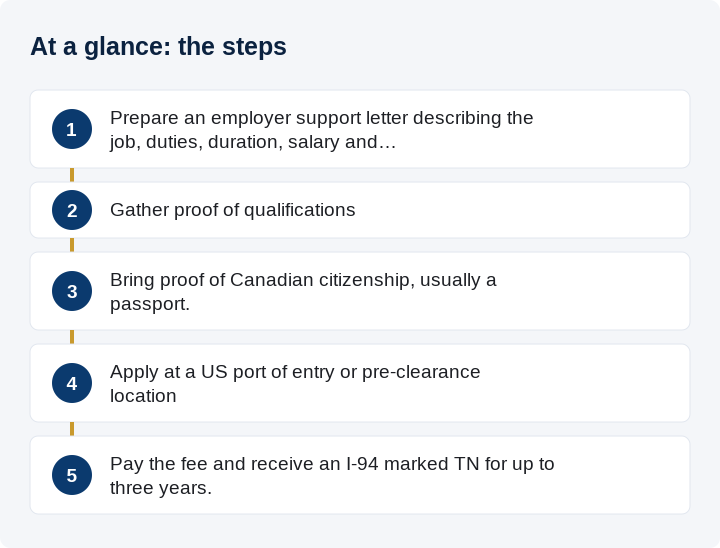
Canadians can also apply through USCIS with Form I-129, which is common for extensions or for changes of status inside the US.
Spouses and unmarried children under 21 receive TD status. They can study but cannot work. Family members do not need to be Canadian or Mexican, but non-Canadian family members of Canadians need visas.
Each TN admission or approval lasts up to three years. There is no limit on renewals, but each must show the job remains temporary in nature. Officers may question applicants who have held TN status for many years and show signs of permanent intent, such as a pending green card process.
The TN does not allow dual intent. Starting an immigrant petition does not automatically end TN status, but it can make renewals and border crossings harder, because officers may conclude the person intends to stay permanently. Common strategies:
A hypothetical Canadian civil engineer with a bachelor's degree accepts a two-year contract with a Seattle firm. At the Vancouver airport pre-clearance, she presents her passport, her original degree, her provincial engineering license and the employer's letter. The officer approves TN status for two years. Later her employer wants to sponsor her for a green card, so she discusses with an attorney whether to switch to H-1B first to avoid intent problems at future border crossings.
Working physically outside the US does not need a US visa. The TN is for work performed in the US.
Yes, but the new employer needs a new TN application or petition before you start.
No. There is no annual cap.
Buying property is allowed, but it can be one factor officers consider when assessing temporary intent.
Yes, on US income, and possibly on worldwide income if they become US tax residents under the substantial presence test.
Disclaimer. This article is general information, not legal advice, and it is not affiliated with any government agency. US immigration rules, fees and processing times change often, and they changed repeatedly in 2025 and 2026. Confirm current requirements on uscis.gov and travel.state.gov, or speak with a licensed immigration attorney or a DOJ-accredited representative.
How the J-1 visa works for researchers, students, interns, au pairs, teachers and physicians, the DS-2019, insurance rules, the two-year home residency requirement and waivers.
How the B-1/B-2 visitor visa works: allowed and forbidden activities, the interview, proving ties to home, length of stay, extensions, overstays and the new visa integrity fee.
How the Visa Waiver Program and ESTA work: eligible countries, the $40 fee, 90-day stays, ineligibility after travel to certain countries, and what you cannot do on ESTA.