O-1 Visa for Extraordinary Ability: Criteria, Evidence and Strategy
How the O-1A and O-1B visas work for people with extraordinary ability in science, business, education, athletics, arts and film, with criteria, agents and green card options.
 Tradiciones del Mundo
The L-1 lets international companies move their own people to the US without a lottery. It is also the classic route to the EB-1C green card for managers.
Key points
Global companies use the L-1 to send executives to lead US operations, specialists to transfer know-how, and founders to open a US subsidiary. The visa depends on the corporate relationship between the foreign and US entities and on the employee's role. This guide explains both subcategories, the special rules for new offices and how L-1 holders become permanent residents.
The L-1 is about the company as much as the person: the relationship between the entities must be proven as carefully as the job.
| L-1A | L-1B | |
|---|---|---|
| Role | Manager or executive | Specialized knowledge of the company's products, processes or procedures |
| Maximum stay | 7 years | 5 years |
| Initial approval | Up to 3 years (1 year for new offices) | Up to 3 years (1 year for new offices) |
| Green card path | EB-1C, no PERM | Usually PERM-based EB-2 or EB-3 |
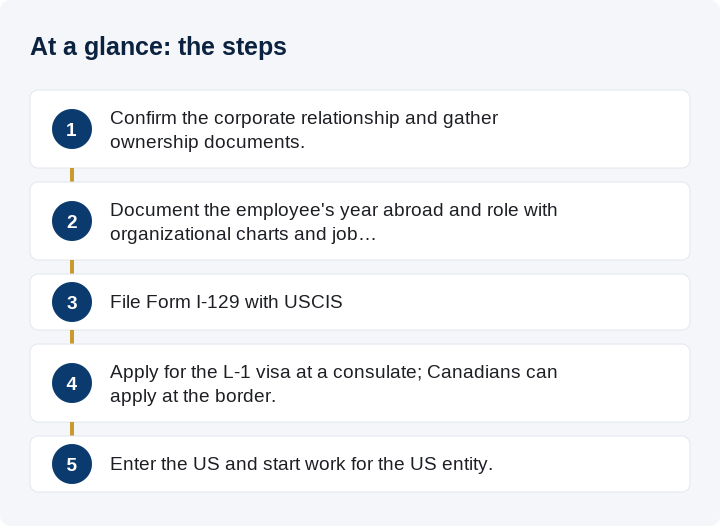
A company can send an executive or specialist to open a US office. The petition must show secured physical premises, the foreign company's financial ability to support the new office, and a business plan showing the office will support a managerial position within one year. Initial approval is limited to one year, and the extension requires evidence that the office is operating and has grown.
Large multinationals meeting size thresholds can obtain a blanket L approval. Employees then apply directly at a US consulate with Form I-129S, skipping individual USCIS petitions, which speeds up transfers.
Spouses and children receive L-2 status. Since 2022, L-2 spouses are authorized to work incident to their status, and their I-94 can serve as evidence of work authorization.
L-1A managers commonly move to the EB-1C category once the US entity has done business for a year. L-1B specialists usually need an employer-sponsored PERM case. Both L categories allow dual intent. See EB-1C for multinational managers.
A hypothetical software company in Spain with 40 employees decides to open a US subsidiary in Florida. Its operations director, who has led a team of five engineers for three years, is transferred on an L-1A under the new office rules. The petition includes the lease for a small office, bank statements showing the parent can fund the US entity for a year, a business plan projecting the hiring of a sales manager and two engineers, and organizational charts. After one year, the extension shows the US company has hired staff, signed customers and is paying the director a salary. Once the US entity has done business for a year and the director manages other managers or professionals, the company files an EB-1C petition.
USCIS looks for knowledge that is special or advanced compared with others in the industry or within the company, for example deep knowledge of proprietary software, manufacturing processes or client systems that would take significant time and cost to transfer to a new hire. Simply being a skilled engineer is not enough; the petition should explain what the employee knows that others do not and why it matters for the US operation.
Canadian citizens can apply for L-1 status directly at a port of entry or pre-clearance location with the petition documents, without a visa stamp, which speeds up transfers between Canada and the US.
The L-1 fits when a real multinational group exists, the employee has a year with the foreign entity and the US role is either managerial or relies on knowledge specific to the company. It does not fit freelancers, employees of unrelated companies or people who have not yet worked a full year abroad.
Yes, if a foreign company with real operations opens a US subsidiary and the transferee meets the requirements.
No, but brief trips to the US do not interrupt the year; the time spent in the US simply does not count.
No. The L-1 is tied to the multinational group.
Disclaimer. This article is general information, not legal advice, and it is not affiliated with any government agency. US immigration rules, fees and processing times change often, and they changed repeatedly in 2025 and 2026. Confirm current requirements on uscis.gov and travel.state.gov, or speak with a licensed immigration attorney or a DOJ-accredited representative.

How the O-1A and O-1B visas work for people with extraordinary ability in science, business, education, athletics, arts and film, with criteria, agents and green card options.
How Canadian and Mexican professionals work in the US under TN status: the USMCA profession list, requirements, applying at the border or a consulate, renewals and green card risks.

How the J-1 visa works for researchers, students, interns, au pairs, teachers and physicians, the DS-2019, insurance rules, the two-year home residency requirement and waivers.