TN Visa for Canadians and Mexicans: USMCA Professionals Guide
How Canadian and Mexican professionals work in the US under TN status: the USMCA profession list, requirements, applying at the border or a consulate, renewals and green card risks.
 Tradiciones del Mundo
The O-1 has no lottery and no annual cap. It rewards a record of achievement, and it has become a key alternative for people who miss the H-1B.
Key points
Founders, researchers, engineers, athletes, artists and film professionals use the O-1 to work in the US based on their achievements rather than an employer lottery. Its evidence resembles the EB-1A green card, but the standard is lower, which makes the O-1 a common stepping stone. This guide explains both versions, the evidence USCIS expects and practical strategy.
Evidence of achievement is cumulative. Start documenting press, awards, judging and impact years before you need the visa.
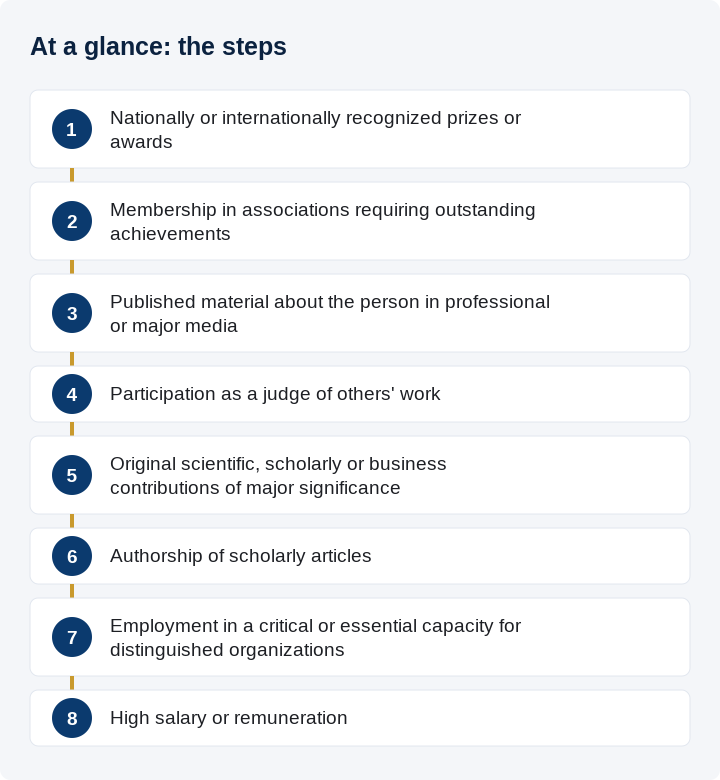
Applicants show sustained national or international acclaim through a major internationally recognized award, or at least three of these:
Comparable evidence is accepted when the criteria do not readily apply. In recent years USCIS has published guidance explaining how the criteria apply to STEM fields and startup founders.
For the arts, the standard is distinction: a high level of achievement and recognition. For motion pictures and television, the standard is higher: extraordinary achievement with a record of recognition. Evidence includes leading roles, critical reviews, commercial success and awards.
A US employer, or a US agent acting for several employers or for the worker, files Form I-129. Agents are common for freelancers, consultants and artists with multiple engagements. Self-petitioning is not allowed, but a company you own can petition for you.
Spouses and children receive O-3 status and can study but not work. Essential support personnel for O-1 artists or athletes can receive O-2 status.
| O-1 | H-1B | |
|---|---|---|
| Lottery | No | Yes, for most new workers |
| Degree required | No | Yes, in a specific field |
| Maximum stay | Unlimited one-year extensions | Six years, with green card exceptions |
| Evidence burden | High | Moderate |
| Spouse can work | No | Only with H-4 EAD conditions |
The O-1 tolerates immigrant intent in practice. Many O-1 holders file for EB-1A or a National Interest Waiver, reusing much of the evidence.
Consider a hypothetical machine learning engineer who co-founded a startup that raised venture funding. She has published four peer-reviewed papers with several hundred citations, reviews papers for two international conferences, was featured in a national technology publication and earns well above the median salary for her occupation. Her evidence maps to at least four O-1A criteria: authorship, judging, published material about her and high remuneration, with original contributions arguable through adoption of her open-source model. Her company petitions for her, with a consultation letter from a professional association in her field and letters from independent experts at universities and other companies who explain how her work is used.
Had she had only a degree, two years of experience and no external recognition, the O-1 would likely fail, and the H-1B lottery or a cap-exempt employer would be more realistic.
After the initial period of up to three years, extensions are granted in increments of up to one year to continue the same event or activity. There is no overall limit, which makes the O-1 attractive for people whose green card is delayed by backlogs.
Building the record itself (publications, judging, press) takes much longer, which is why early documentation matters.
Ask three questions. Do independent people outside your employer know and cite your work? Can you document at least three criteria with strong evidence, not just claims? Do you have a US employer or agent with concrete work planned? If the answer to all three is yes, the O-1 is worth preparing. If not, consider building your record for a year and using another status in the meantime.
No. You need documented recognition in your field, which many specialists, founders and researchers have.
Yes, through an agent petition with an itinerary covering the engagements.
With premium processing, USCIS decides within 15 business days; preparing the evidence often takes longer.
Disclaimer. This article is general information, not legal advice, and it is not affiliated with any government agency. US immigration rules, fees and processing times change often, and they changed repeatedly in 2025 and 2026. Confirm current requirements on uscis.gov and travel.state.gov, or speak with a licensed immigration attorney or a DOJ-accredited representative.
How Canadian and Mexican professionals work in the US under TN status: the USMCA profession list, requirements, applying at the border or a consulate, renewals and green card risks.
How the J-1 visa works for researchers, students, interns, au pairs, teachers and physicians, the DS-2019, insurance rules, the two-year home residency requirement and waivers.
How the B-1/B-2 visitor visa works: allowed and forbidden activities, the interview, proving ties to home, length of stay, extensions, overstays and the new visa integrity fee.