Green Card Costs in 2026: Fees, Affidavit of Support and Public Charge
Every main green card fee in 2026, the I-864 Affidavit of Support income rules and joint sponsors, and how the public charge test works.
 Tradiciones del Mundo
Requests for evidence, long silences, inadmissibility findings and denials are all part of the system. Each has a defined response, and deadlines that matter.
Key points
Even well-prepared cases run into problems. This guide covers them in order of severity: a request for more evidence, a case stuck beyond normal processing times, a finding that you are inadmissible, and finally a denial.
An RFE is not a denial. It is a chance to fix a gap in your file.
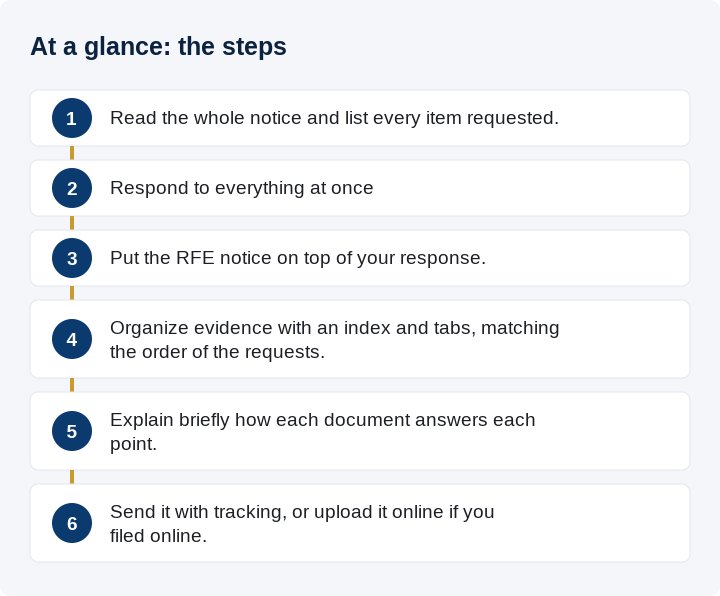
An RFE is not a denial. It is a chance to fix a gap in your file, and the quality of your response often decides the case.
USCIS issues a Request for Evidence when the file does not yet establish eligibility. The notice lists what is missing or insufficient and the deadline to respond, usually 84 days plus mailing time (the deadline on the notice is what counts). Deadlines cannot be extended.
A Notice of Intent to Deny (NOID) means USCIS has evidence that the case should be denied and gives you a chance to rebut it, usually in 30 days. A NOID is more serious and usually requires legal help.
A hypothetical family case receives an RFE requesting the sponsor's most recent tax transcript and evidence of current employment. The response includes the RFE notice on top, a cover letter listing two exhibits, Exhibit A (IRS transcript for the latest tax year) and Exhibit B (a recent employer letter and three pay stubs). It is sent well before the deadline with tracking. The case is approved weeks later.
Waiting is the hardest part. Knowing where to look tells you whether your case is normal or stuck.
Use your 13-character receipt number (for example IOE0912345678) on the USCIS Case Status Online page or in your USCIS online account. The status is general ("Case Was Received", "Fingerprint Fee Was Received", "Interview Was Scheduled") and may not update for months.
The USCIS processing times page shows, for each form and office, the time in which 80% of cases were completed. If your case is older than the posted time, you can submit an online case inquiry.
USCIS considers expedites for severe financial loss, urgent humanitarian reasons, nonprofit organizations furthering US interests, US government interests and clear USCIS errors. Requests are made by phone or online and need documentary evidence.
When a case is delayed far beyond reasonable times, a lawsuit in federal court asking the court to order a decision is possible. It is not always appropriate; talk to a lawyer.
Inadmissibility grounds are the reasons a person can be refused a green card even with a valid petition. Many can be waived, but only with the right form and evidence.
| Unlawful presence | Bar when you leave the US |
|---|---|
| More than 180 days, less than 1 year | 3 years |
| 1 year or more | 10 years |
| More than 1 year total, then re-entering or trying to re-enter illegally | Permanent (can request permission after 10 years outside) |
Unlawful presence generally does not accrue before age 18 or while a bona fide asylum application or I-485 is pending.
Hardship to the applicant does not count; it must be to the qualifying relative. Evidence covers health, finances, education, country conditions, family ties and the effect of separation or relocation.
A hypothetical man entered the US without inspection in 2015 and married a US citizen in 2024. To get a green card he must interview in his home country. Because he accrued more than a year of unlawful presence, leaving triggers the 10-year bar. Before leaving, he files an I-601A showing that his wife, who has a medical condition and a job she cannot transfer, would suffer extreme hardship. Once the waiver is approved, he attends the consular interview, and the bar is waived.
A denial is not always the end. What you can do depends on who denied the case, why, and your status at the time.
The denial notice explains the legal reasons and whether you can appeal or file a motion. Note the deadline: usually 30 days (33 if mailed) for motions and appeals.
Using Form I-290B ($800), a motion to reopen presents new facts with evidence; a motion to reconsider argues that USCIS misapplied the law or policy based on the existing record. I-485 denials generally cannot be appealed to the AAO, so a motion is often the only USCIS option.
Denials of petitions such as I-140s and some I-360s can be appealed to the Administrative Appeals Office. I-130 denials are appealed to the Board of Immigration Appeals with Form EOIR-29.
If you have no other status, USCIS may issue a Notice to Appear. Before an immigration judge you can often renew your adjustment application. Since 2025 USCIS has issued Notices to Appear more frequently after denials.
If the problem was a missing document or a fixable eligibility issue, filing a new, complete application may be faster than a motion. Make sure you remain in status.
Visa refusals abroad have very limited review. You can provide additional evidence to the consulate if refused under 221(g), seek a waiver, or ask the petitioner to file again.
A hypothetical applicant's I-485 is denied because USCIS concluded she failed to maintain status. She believes USCIS miscounted her days. She files an I-290B motion to reconsider within 33 days, with a brief showing the correct dates and evidence. If the motion is denied and she is placed in removal proceedings, she can ask the immigration judge to grant adjustment.
Every denial deserves at least a consultation. Deadlines are short and choices made in the first weeks, such as whether to file a motion or refile, can be decisive.
No. USCIS does not extend RFE deadlines, so plan to respond early.
Explain why and provide the best secondary evidence available.
Not necessarily. Many approved cases received at least one RFE.
No. USCIS decides after the first response, so send everything at once.
Often yes. Status updates only at key steps. Compare your receipt date with posted processing times.
Applicants cannot choose. USCIS sometimes transfers cases to balance workloads.
It can help with cases outside normal times, but it does not jump the line.
Most waivers require a US citizen or resident spouse or parent; some humanitarian categories have broader waivers.
Often a year or more, depending on the form and office.
No. Drug trafficking and some other grounds have no waiver.
Yes, an EAD based on a pending I-485 is no longer valid once the I-485 is denied.
Only if you have another status or a pending case that protects you. Talk to a lawyer immediately.
No.
Disclaimer. This article is general information, not legal advice, and it is not affiliated with any government agency. US immigration rules, fees and processing times change often, and they changed repeatedly in 2025 and 2026. Confirm current requirements on uscis.gov and travel.state.gov, or speak with a licensed immigration attorney or a DOJ-accredited representative.
Every main green card fee in 2026, the I-864 Affidavit of Support income rules and joint sponsors, and how the public charge test works.
How US immigration court works: the Notice to Appear, master and individual hearings, defenses such as asylum and cancellation, appeals to the BIA and why attending every hearing matters.
Who can legally give immigration advice, how to find and evaluate an immigration attorney or accredited representative, typical fees, free help and how to spot notario fraud.