ESTA and the Visa Waiver Program: Who Qualifies and the Limits
How the Visa Waiver Program and ESTA work: eligible countries, the $40 fee, 90-day stays, ineligibility after travel to certain countries, and what you cannot do on ESTA.
 Tradiciones del Mundo
The visitor visa covers tourism, family visits, medical treatment and short business trips. It does not cover work, and officers assume you plan to stay until you prove otherwise.
Key points
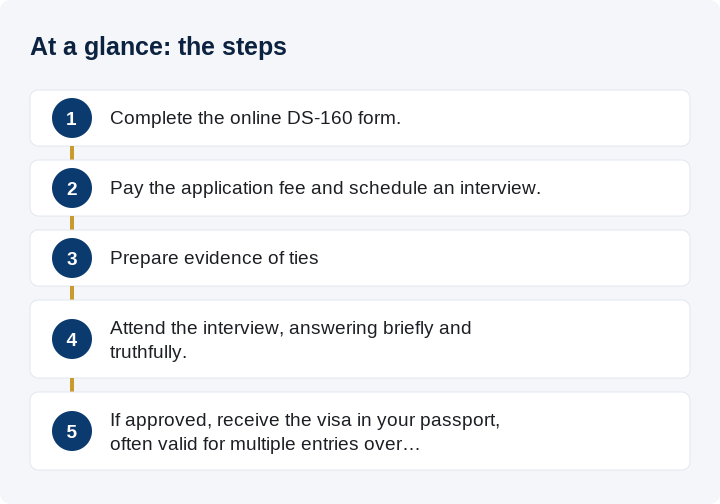
Most visitors from countries outside the Visa Waiver Program need a B-1/B-2 visa to come to the US. It is the visa used by parents visiting immigrant children, tourists, business travelers attending meetings, and patients seeking treatment. Because it is the most applied-for visa in the world, it is also the most refused. This guide explains what you can and cannot do, how the interview works and how to protect your future applications.
The visa gets you to the border. The I-94 record decides how long you can stay.
| B-1 (business) | B-2 (tourism and personal) |
|---|---|
| Meetings with business associates | Tourism and vacations |
| Conferences and trade shows | Visiting family and friends |
| Negotiating contracts | Medical treatment |
| Settling an estate | Social events and amateur competitions |
| Short training without productive work (in limited cases) | Short recreational courses not for credit |
Remote work for a foreign employer during a visit sits in a gray area that the State Department has addressed only partially; brief, incidental work is generally tolerated, but long stays to work remotely are risky.
The 2025 budget law created a visa integrity fee for many nonimmigrant visas, including B visas, with implementation details set by the government. Check the current fee schedule on travel.state.gov before applying.
Officers presume immigrant intent under section 214(b). Typical evidence of strong ties includes a stable job with approved leave, a business you run, enrolled studies, a spouse and children at home, property, and a history of returning on time from earlier trips. A detailed itinerary and evidence of funds help.
CBP usually admits visitors for up to six months. Check the date on your I-94 online. To stay longer, file Form I-539 before the I-94 expires, explaining the reason. Overstaying by even one day voids the visa, and overstays of more than 180 days can trigger a three-year bar on returning.
Parents visiting children who live in the US are among the most common B-2 travelers. A pending immigrant petition for the parent makes the visit harder, since it shows immigrant intent, though it does not prohibit it. Parents should buy visitor health insurance, because US care is expensive and Medicare does not cover visitors.
A hypothetical retired couple from Peru wants to visit their daughter, who lives in Texas, for three months after the birth of her baby. At the interview they show their pension statements, the deed to their house in Lima, their prior US trips with timely returns and a letter from their daughter. The officer approves a multiple-entry visa. CBP admits them for six months, but they leave after three, as planned. Their consistent travel history makes future visits easier.
Officers decide quickly, often in a few minutes, so a clear and honest explanation matters more than documents.
A visa valid for ten years does not allow ten years of presence. Each entry gives a new I-94 with its own departure date, and officers look at how much of the year you spend in the US. Spending most of each year in the US on visitor status can lead to refusals at the border or cancellation of the visa.
Yes, marrying is allowed. Filing for a green card soon after entry raises intent questions; see immigrant intent.
Any time, but only reapply if your circumstances have changed or you can present them better.
Since 2020, consular officers must refuse B visas to applicants whose primary purpose is to give birth in the US to obtain citizenship for the child.
Attending interviews is allowed; starting work is not.
Disclaimer. This article is general information, not legal advice, and it is not affiliated with any government agency. US immigration rules, fees and processing times change often, and they changed repeatedly in 2025 and 2026. Confirm current requirements on uscis.gov and travel.state.gov, or speak with a licensed immigration attorney or a DOJ-accredited representative.
How the Visa Waiver Program and ESTA work: eligible countries, the $40 fee, 90-day stays, ineligibility after travel to certain countries, and what you cannot do on ESTA.
How the H-1B specialty occupation visa works: eligibility, the annual lottery, the $100,000 fee on some new petitions, wage-weighted selection, extensions and the path to a green card.
How the F-1 student visa works: the I-20, maintaining status, on-campus work, CPT, OPT, the 24-month STEM extension, cap-gap and the path to H-1B or a green card.