EB-2 Green Card and the National Interest Waiver (NIW)
Who qualifies for EB-2 with an advanced degree or exceptional ability, how foreign degrees are evaluated, and how the National Interest Waiver works under Dhanasar.
 Tradiciones del Mundo
EB-1 is the fastest employment route for most countries and needs no labor certification. Each of its three subcategories rewards a different kind of career.

Key points
EB-1 is often described as the green card for "geniuses", but that is misleading. A researcher with well-cited work, a manager transferred from a foreign branch or an artist with sustained acclaim may all qualify. The sections below explain each subcategory, the evidence officers expect and the most common reasons petitions fail.
the alien has extraordinary ability in the sciences, arts, education, business, or athletics which has been demonstrated by sustained national or international acclaim and whose achievements have been recognized in the field through extensive documentation
EB-1A is the only work-based green card you can file for yourself with no job offer. The bar is high, but it is clearer than its reputation suggests.
People with extraordinary ability in the sciences, arts, education, business or athletics, demonstrated by sustained national or international acclaim, who will continue working in their field in the US. No employer sponsor and no labor certification are required.
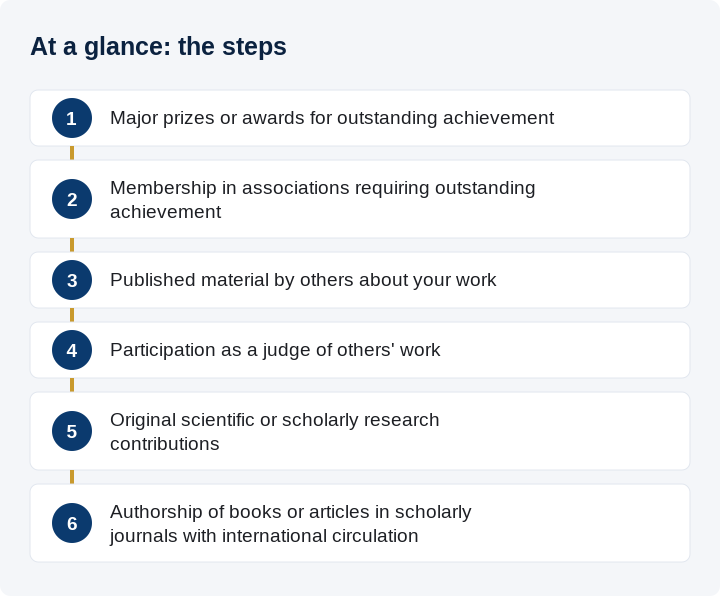
You qualify either with a one-time major internationally recognized award (think Nobel Prize or Olympic medal) or by meeting at least three of these:
Comparable evidence can be used if a criterion does not readily apply to your occupation.
Meeting three criteria is not enough. USCIS then looks at the evidence as a whole and asks whether you are one of the small percentage at the very top of the field with sustained acclaim. Many denials happen at this second step, not the first.
Form I-140 costs $715 plus a $600 Asylum Program Fee for self-petitioners, under the April 2024 schedule. Premium processing is available for an extra fee and gives a decision within 15 business days. EB-1 is usually current for most countries, but not for India and China.
EB-1B gives universities and research employers a fast route to sponsor leading academics, without labor certification.
Meet at least two:
As with EB-1A, USCIS then reviews whether the evidence as a whole shows international recognition.
EB-1B needs an employer, while EB-1A and the National Interest Waiver do not. In exchange, the EB-1B standard (international recognition as outstanding) is somewhat lower than EB-1A's "small percentage at the very top". Researchers on postdoc contracts usually do not qualify for EB-1B because the position is temporary.
Strong EB-1B petitions show international recognition through independent sources: citations by researchers in other countries, invitations to review for international journals, conference invitations, and letters from independent experts explaining how the researcher's work changed the field. The employer's offer letter must clearly describe the permanent or tenure-track nature of the job.
EB-1C is the natural next step for many L-1A managers. It needs no labor certification, but the definition of "manager" is narrower than most job titles.
USCIS looks at actual duties, not titles. A manager mainly manages the organization or a department or function, supervises other managers or professionals (or manages an essential function), and has authority over personnel decisions. An executive directs the management of the organization and sets goals and policies with wide discretion. People who spend most of their time performing the services of the business themselves often do not qualify.
Petitions from small US subsidiaries receive close scrutiny. USCIS considers the company's reasonable needs and stage of development, but must see that someone other than the beneficiary does the day-to-day work.
A common pattern: a manager working for a company abroad for a year transfers to the US affiliate on an L-1A visa. Once the US entity has done business for a year, it files an EB-1C petition. Because L-1A allows dual intent, the manager can stay in status while waiting. The L-1A has a seven-year limit, so timing matters.
Yes. Many O-1 holders file EB-1A because the evidence overlaps, though the EB-1A standard is higher.
Yes. If approved, you complete consular processing.
Postdoctoral research experience counts. Research during doctoral studies counts only if the degree was obtained and the research was recognized as outstanding.
Yes, if it employs at least three full-time researchers and has documented research accomplishments.
After I-140 approval you keep the priority date; after 180 days with a pending I-485 you may port to a same or similar job.
The US company must have been doing business for at least one year at filing.
Yes, if they manage an essential function at a senior level, though USCIS will want detailed evidence of who performs the daily tasks.
Disclaimer. This article is general information, not legal advice, and it is not affiliated with any government agency. US immigration rules, fees and processing times change often, and they changed repeatedly in 2025 and 2026. Confirm current requirements on uscis.gov and travel.state.gov, or speak with a licensed immigration attorney or a DOJ-accredited representative.
Who qualifies for EB-2 with an advanced degree or exceptional ability, how foreign degrees are evaluated, and how the National Interest Waiver works under Dhanasar.

The path from H-1B to permanent residence: PERM labor certification, Form I-140, extending H-1B past six years, and changing employers under AC21 portability.

How internationally educated nurses immigrate to the US: Schedule A (no PERM recruitment), the NCLEX, VisaScreen certificates, state licensing, EB-3 backlogs and recruiter contracts.