Green Card vs Citizenship: Rights, Dual Nationality and Children
How permanent residents and citizens differ in rights and risks, how dual citizenship works, and how children become citizens automatically or with Form N-600.
 Tradiciones del Mundo
Before you become a citizen, USCIS reviews your conduct, and at the end you take an oath that changes your legal identity. Service members follow a faster track.

Key points
This guide covers the last stage of the citizenship journey: the moral character review that can delay or deny a case, the special track for those who serve in the armed forces, and the ceremony where you become a citizen.
I hereby declare, on oath, that I absolutely and entirely renounce and abjure all allegiance and fidelity to any foreign prince, potentate, state, or sovereignty, of whom or which I have heretofore been a subject or citizen
Good moral character is judged mainly on the last five years, but some acts disqualify you forever. Since 2025, USCIS also looks at positive contributions.
USCIS focuses on the 5 years before filing (3 under the marriage rule) until the oath, but can consider conduct before that period.
An August 2025 USCIS policy memo directed officers to weigh both negative conduct and positive attributes, such as community involvement, family responsibilities, education and work history, and to look more closely at conduct that is lawful but socially undesirable. Expect more questions than before.
A hypothetical applicant owes back taxes from three years ago. Before filing, she sets up an IRS installment agreement and brings proof of payments to the interview. The officer considers the payment plan a sign of responsibility and does not find a lack of good moral character on that basis.
Anyone with an arrest, conviction, unpaid taxes, child support arrears, a false claim to citizenship, a past immigration violation or a history of DUI should consult an immigration lawyer before filing the N-400. Applying can trigger removal proceedings for people who are deportable.
The US has offered faster citizenship to non-citizens who serve in its armed forces since the Revolutionary War.
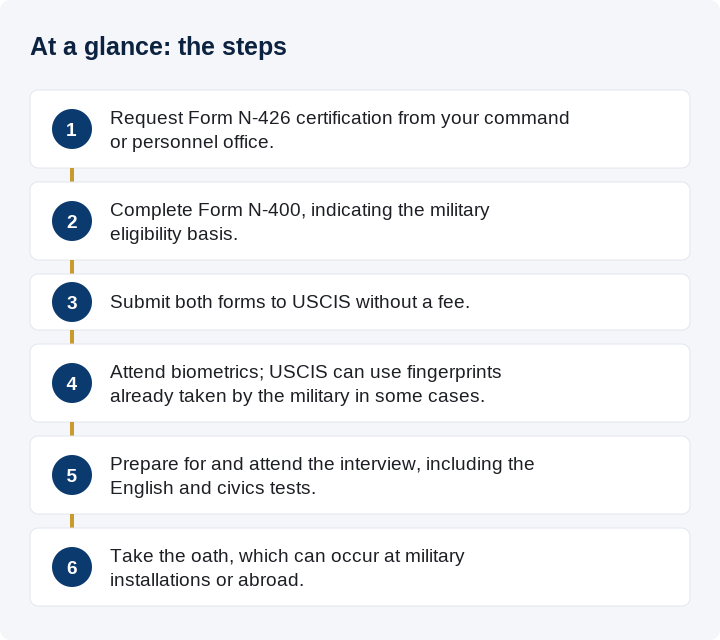
Permanent residents who served honorably for at least one year can naturalize, filing while serving or within six months of discharge. They are exempt from the usual residence and physical presence requirements.
Those who served honorably during designated periods of hostilities, which have included every day since 11 September 2001, can naturalize after any length of service, without being permanent residents if they enlisted in the US or certain territories.
Spouses and children of service members may have special naturalization and residence provisions. Posthumous citizenship is available for those who die in service.
A hypothetical permanent resident enlisted in the US Army and served honorably for two years. Under INA 329, because he served during a designated period of hostilities, he can apply immediately, without the usual residence or physical presence periods, and with no N-400 fee. He files the N-400 with an N-426 certified by his command.
Service must be honorable. People who naturalize through military service and are later separated under other than honorable conditions before completing five years of honorable service can have their citizenship revoked. Keep records of your service characterization.
Each military branch has legal assistance offices that help with naturalization. USCIS also maintains a dedicated military help line and email for service members and families.
The oath is the moment you become a US citizen. After it, a few practical steps finish the transition.
You receive Form N-445, the ceremony notice, usually a few weeks after approval. Some field offices hold same-day ceremonies after the interview; others hold large judicial ceremonies in courts.
Complete the questionnaire on the back of the N-445 about events since your interview (travel, arrests, marriage). Bring your green card, the N-445 and any re-entry permit.
The Oath of Allegiance includes renouncing prior allegiances, supporting the Constitution and agreeing to bear arms or perform non-combatant or civilian service when required by law. Applicants with religious or moral objections can request modifications.
USCIS conducts administrative ceremonies at its field offices. Some federal and state courts hold judicial ceremonies, often larger and more formal, with a judge administering the oath. Applicants who want a legal name change may be scheduled for a judicial ceremony where the court can grant it. Both types produce the same result: you are a citizen once the oath is taken.
Apply for your US passport promptly if you plan to travel: you must use a US passport to leave and enter the US from now on. Update your status with the Social Security Administration so employment and benefit records reflect your citizenship. If you have children under 18 with green cards living with you, they may now be citizens too.
Minor tickets under $500 generally do not, but you must disclose them if asked.
They must be disclosed and USCIS may consider the underlying conduct.
A single DUI is not an automatic bar, but multiple DUIs within the period create a presumption against good moral character.
Generally only permanent residents and citizens can enlist; a past program for certain non-residents ended.
Yes, with honorable service.
Spouses of service members stationed abroad may be eligible for overseas processing.
Often yes, but space varies; check the notice.
Return the notice with a request to reschedule.
Once registered, at the next election.
Report it at the ceremony or file Form N-565.
No, you surrender it.
Disclaimer. This article is general information, not legal advice, and it is not affiliated with any government agency. US immigration rules, fees and processing times change often, and they changed repeatedly in 2025 and 2026. Confirm current requirements on uscis.gov and travel.state.gov, or speak with a licensed immigration attorney or a DOJ-accredited representative.

How permanent residents and citizens differ in rights and risks, how dual citizenship works, and how children become citizens automatically or with Form N-600.

Step-by-step naturalization guide: eligibility, Form N-400, fees and the reduced fee, filing 90 days early, biometrics, the interview and the oath.

The residence tests for naturalization: continuous residence and long trips, counting physical presence days, and the three-year rule for spouses.