US Citizenship Test and Interview: Civics, English and What to Expect
How the naturalization interview works, the 2025 civics test (128 questions, 12 correct of up to 20), the English test and the age-based exemptions.
 Tradiciones del Mundo
Most applicants who are "not yet eligible" for citizenship fail one of two residence tests. Both are arithmetic, if you know the rules.

Key points
Frequent travelers, people with family abroad and couples who married recently should read this guide before filing. It explains how USCIS counts trips and days and how the three-year marriage rule works in practice.
Many short trips can leave continuous residence intact while still leaving you short of physical presence. Both tests must be met.
Continuous residence is the most common reason frequent travelers are not yet eligible for citizenship. The rules hinge on two numbers.
You must have resided continuously in the US as a permanent resident for 5 years (or 3 under the marriage rule) before filing, and from filing until you take the oath.
| Single trip | Effect |
|---|---|
| Less than 6 months | No break |
| 6 months to less than 1 year | Presumed break, which you can rebut |
| 1 year or more | Break (unless an approved N-470 applies) |
For trips between 6 and 12 months, show that you kept your US life: you did not quit your US job or take a full-time job abroad, your immediate family stayed in the US, you kept your home and filed US taxes as a resident.
After a trip of a year or more, you can generally apply again 4 years and 1 day after returning (2 years and 1 day under the 3-year rule).
Employees of the US government, US companies or certain organizations, and religious workers, can file N-470 to preserve residence for absences of a year or more. It must be filed before the absence reaches one year and does not preserve physical presence.
A hypothetical resident since March 2021 spent seven months in Brazil in 2023. She kept her US job (remote work for her US employer), her apartment and filed US taxes. When she applies in 2026, USCIS presumes a break because of the trip over six months. She rebuts it with evidence of her lease, employer letter and tax returns, and the officer accepts that continuous residence was maintained.
Physical presence is simple arithmetic, but it trips up people who travel often in short trips.
You must have been physically present in the US for at least 30 months (913 days) of the 5 years before filing, or 18 months (548 days) of the 3 years under the marriage rule.
Many short trips can leave your continuous residence intact while still leaving you short of physical presence. Both tests must be met.
Some groups, such as certain military members, spouses of US citizens employed abroad by qualifying organizations, and some others, are exempt or have special rules.
A hypothetical consultant has been a resident for five years and travels for work. She lists 34 trips totaling 1,000 days abroad. Her physical presence is about 826 days, below the 913 required. Although no single trip broke continuous residence, she must wait until the five-year window before filing contains at least 913 days in the US.
Check your days: enter your days abroad in the citizenship eligibility date calculator.
Spouses of US citizens can naturalize two years earlier than everyone else, as long as the marriage meets a specific test for the whole period.
You must actually live together. Separation, even informal, can break the marital union. Temporary separations for work or military service may be acceptable if the relationship continues.
If that happens, you can still naturalize under the regular five-year rule once you meet it.
Spouses of US citizens employed abroad by the US government, certain US companies or organizations may naturalize without any period of residence under INA 319(b).
A hypothetical resident got her green card through marriage in January 2023. In October 2025, 90 days before her third anniversary as a resident, she files her N-400, still married and living with her US citizen husband. If she had separated in 2025, she would need to wait until five years as a resident.
Short trips under six months do not break continuous residence, but they reduce physical presence.
No. It protects the green card, not the naturalization timeline.
Yes, though you can apply 4 years and 1 day after returning from a trip of over a year.
Yes, continuous residence is required until you take the oath.
Yes, every day outside the US counts as absence, though a day of departure or return counts as present.
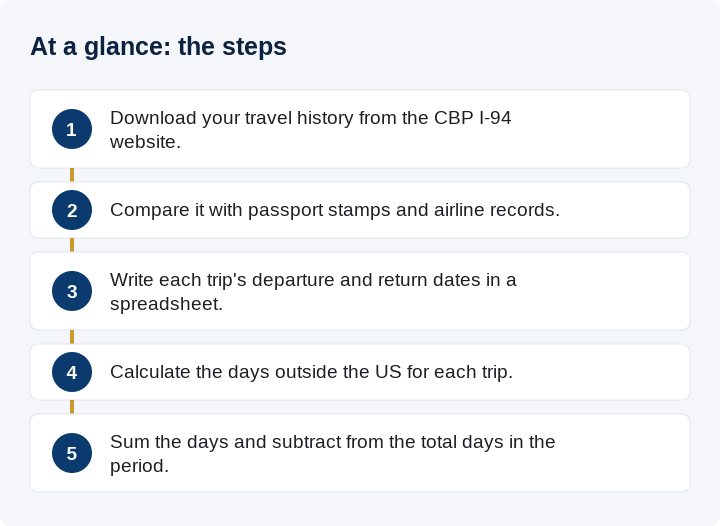
Use the CBP travel history tool, passport stamps, flight records and calendars. Be as accurate as possible.
Time outside US territorial waters is generally time abroad.
Yes, using CBP records.
Yes.
Yes, if you have been married to and living with the citizen spouse for three years while a resident.
Usually not required, but bring evidence of the marital union.
Disclaimer. This article is general information, not legal advice, and it is not affiliated with any government agency. US immigration rules, fees and processing times change often, and they changed repeatedly in 2025 and 2026. Confirm current requirements on uscis.gov and travel.state.gov, or speak with a licensed immigration attorney or a DOJ-accredited representative.

How the naturalization interview works, the 2025 civics test (128 questions, 12 correct of up to 20), the English test and the age-based exemptions.

The final citizenship hurdles: good moral character bars and the 2025 policy, faster naturalization through military service, and the oath ceremony.

How permanent residents and citizens differ in rights and risks, how dual citizenship works, and how children become citizens automatically or with Form N-600.