ITIN Explained: Who Needs One, How to Apply and How to Use It
The ITIN lets people who cannot get a Social Security number file US taxes, open some accounts and claim certain benefits. It does not authorize work or change immigration status.
An ITIN is a nine-digit tax number issued by the IRS to people who need one but cannot get an SSN.
Apply with Form W-7, usually attached to a federal tax return.
ITINs expire if not used on a federal return for three consecutive years.
An ITIN does not authorize work, provide immigration status or qualify you for Social Security.
The Internal Revenue Service issues Individual Taxpayer Identification Numbers (ITINs) so that everyone with US tax obligations can file, whatever their immigration status. Millions of people use ITINs: nonresident investors, spouses and children of visa holders, and immigrants without work authorization who pay taxes on their income. This guide explains who needs an ITIN, how to get one and what it can be used for.
An ITIN always begins with the number 9 and has a specific range of middle digits, which distinguishes it from a Social Security number.
Filing taxes with an ITIN creates a record of compliance, which can matter later for immigration applications that ask about tax history.
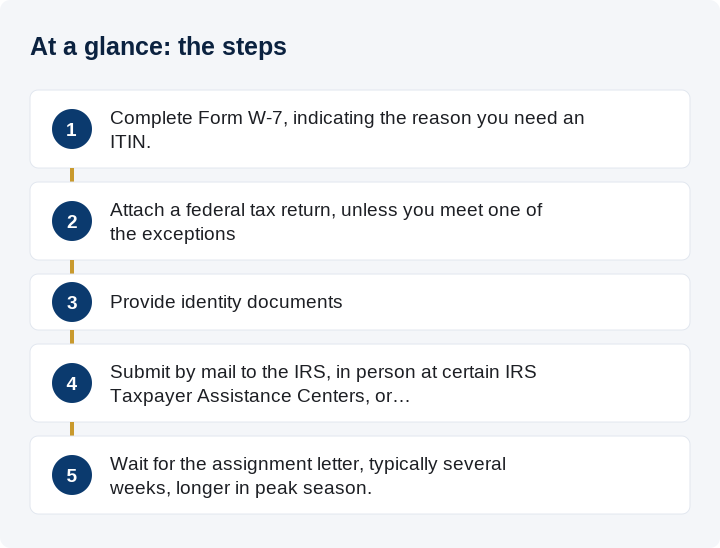
The main steps at a glance. Details in the sections below.
Who needs an ITIN
Nonresident aliens who must file a US tax return, for example because of US rental income or to claim a treaty benefit.
Resident aliens for tax purposes who are not eligible for an SSN.
Spouses and dependents of US citizens, residents or visa holders who are not eligible for an SSN and are claimed on a return (with limits on dependents).
Nonresident students, researchers and professors with taxable scholarships or claiming treaty exemptions.
Anyone eligible for an SSN must use the SSN instead.
How to apply
Complete Form W-7, indicating the reason you need an ITIN.
Attach a federal tax return, unless you meet one of the exceptions (such as certain bank accounts or treaty withholding situations).
Provide identity documents: a valid passport alone is enough because it proves both identity and foreign status; otherwise a combination of other documents.
Submit by mail to the IRS, in person at certain IRS Taxpayer Assistance Centers, or through a Certifying Acceptance Agent (CAA).
Wait for the assignment letter, typically several weeks, longer in peak season.
Mailing original passports is risky; Certifying Acceptance Agents and IRS offices can verify documents in person and return them immediately.
What an ITIN can and cannot do
Can
Cannot
File federal and state tax returns
Authorize employment
Claim some tax credits (such as the credit for other dependents)
Qualify for Social Security benefits
Open some bank accounts and get some loans or mortgages
Claim the Earned Income Tax Credit
Receive tax refunds
Prove immigration status
Build a record of tax compliance
Be used as identification for most federal purposes
Expiration and renewal
An ITIN expires if it is not used on a federal tax return at least once in three consecutive years. ITINs issued before 2013 also expired on a schedule based on their middle digits. To renew, file a new Form W-7 marked as a renewal, ideally before filing the next return, to avoid delays in refunds and credits.
Switching to an SSN
When you become eligible for a Social Security number, for example after receiving a green card or work authorization, apply for the SSN and then write to the IRS to have your tax records under the ITIN combined with the SSN. Stop using the ITIN once you have an SSN.
A worked example
A hypothetical H-1B worker brings his wife, who holds H-4 status without work authorization, and their newborn daughter, a US citizen with an SSN. To file jointly, his wife needs an ITIN. They attach a W-7 to their first joint return, with her passport verified by a Certifying Acceptance Agent. The ITIN arrives several weeks later, and the return is processed. Two years later, when she obtains an H-4 EAD and an SSN, they ask the IRS to merge her records.
Common mistakes
Applying for an ITIN when eligible for an SSN
Sending a W-7 without the required tax return or exception documents
Letting the ITIN expire and losing credits on the next return
Using an ITIN for work authorization purposes
Paying preparers who promise refunds the person does not qualify for
Checklist before applying
Confirm you are not eligible for an SSN.
Prepare a completed federal tax return, unless an exception applies.
Choose how to verify documents: Certifying Acceptance Agent, IRS office or mail.
Gather a valid passport or the required combination of documents.
Keep copies of everything you send.
Glossary
W-7: the ITIN application form.
CAA: Certifying Acceptance Agent, authorized to verify documents.
Assignment letter: the IRS notice with your ITIN.
ITINs for dependents
Dependents who need ITINs must meet additional documentation rules, such as medical or school records for young children, to show US residence where required. Since 2018, dependents with ITINs do not qualify for the full child tax credit, which requires an SSN, but they may qualify for the smaller credit for other dependents. Dependents of nonresidents generally cannot be claimed except for certain treaty countries such as Mexico, Canada and South Korea. Check the W-7 instructions for current rules before applying for a child.
Keep the IRS letter that assigns your ITIN with your important documents; banks and preparers may ask to see it.
If your application is rejected, the IRS letter explains why, usually a missing document or an exception that does not apply; correct it and reapply with the same return.
Frequently asked questions
Does the IRS share ITIN data with immigration authorities?
Taxpayer information is confidential by law, with limited exceptions. A 2025 agreement between the IRS and DHS on sharing certain taxpayer data for enforcement was challenged in court; seek legal advice if you are concerned.
Can I get a credit card with an ITIN?
Some banks and card issuers accept ITINs.
How long does it take?
Usually several weeks, and longer between January and April.
Is there a fee?
The IRS does not charge for ITINs. Acceptance agents and preparers may charge for their services.
Disclaimer. This article is general education, not financial, investment, tax or insurance advice, and it does not recommend any specific product or provider. Prices, rates, limits and rules change; check official sources such as irs.gov, consumerfinance.gov and investor.gov, and consider a licensed professional for decisions about your own money.
How the IRS decides whether a non-citizen is a resident or nonresident for tax purposes: the green card test, the 183-day substantial presence formula, exempt individuals and the first year.
How newcomers file their first US tax return: deadlines, forms (1040 or 1040-NR), W-2 and 1099 forms, deductions and credits, state returns, free help and common mistakes.
How self-employed immigrants pay US taxes: the 15.3% self-employment tax, quarterly estimated payments, deductions, forming an LLC and which visa statuses allow self-employment.
 Tradiciones